|

 t.Lawrence Martyr blood t.Lawrence Martyr blood
Origin of the relic -
The act of the consecration of St. Mary church
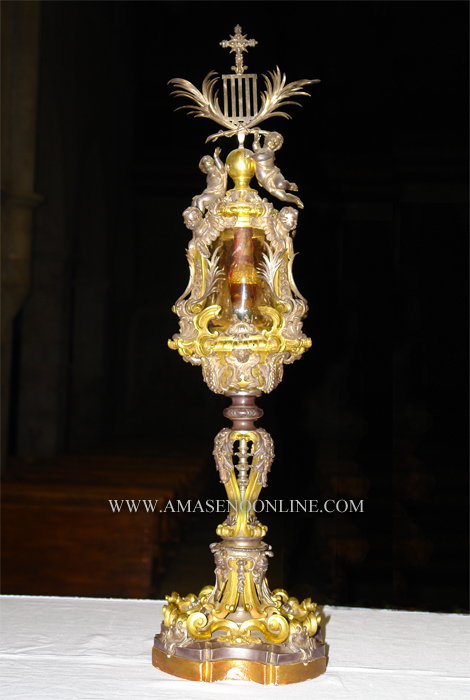
The ampulla of St. Lawrence blood is preserved in St. Mary's Church.
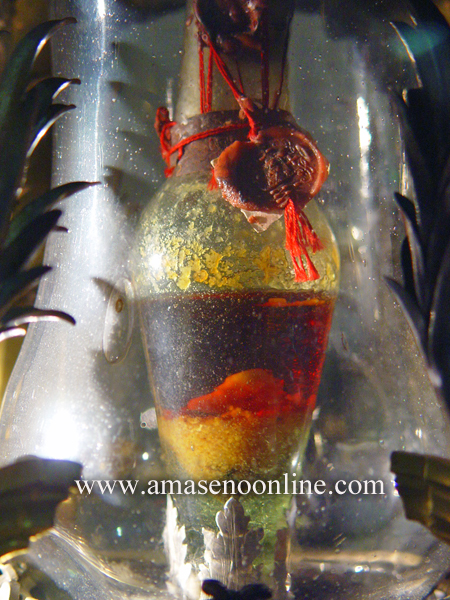
The relic consists of: blood mixed with fat, cinders and
a fragment of skin (50 grams).
The blood is coagulated during all the year. On august
10th and sometimes in some other special occasions,
the blood melts, becoming liquid again.
 ature
of the substance contained in the ampulla ature
of the substance contained in the ampulla
The nature of the substance in the ampulla was thoroughly
investigated during the years.
Dr. Clinio Silvestri (1849 -1900) in his "Monography
about St. Lawrence reliquiary in Amaseno" explains
all the analysis he made which confirmed the authenticity
of the blood.
He studied the relic for about 30 years , during the phase
of liquefaction when it is easier to observe the various
elements that constitute it.
But how can we be sure that the blood really belongs to
the St. Lawrence? Thanks to the old documents and manuscripts
in which the relic is always named of St. Lawrence. In old documents preceding 1600 it is mentioned as «
de pinguedine »
« delle grassecze
», «
dell'onto »,«
dell'adipe »
that is St. Lawrence fat and nothing else.
In those later ones the relic instead seems to be constituted
of various elements: fat, skin, cinders and for the most
part blood: ampulla « cum
sanguine et pinguedine »;
« contenente sangue
, grasso et pelle »;
relic « sanguines
cum carbonis et adipe et pelle »,«
ex sanguine S.Laurentii Martyris ».
This happened because the older documents were worded before
the phenomenon of liquefaction, so they describe the relic
in its solid state when fat is the most evident feature.
On the contrary in the latter, during the liquefaction state
, the relic is described in the phase of melting when the
blood is of a bright-red color and prevails over the other
elements even if they're well evident in the ampulla.
So it is obvious that the documents deal with the same relic.
There is another obscure point to solve: "how can people
be sure that the blood belonged to Saint Lorenzo Martyr
if, as the Aringhi wrote in his memory, the saint were unknown
to the inhabitants?" This what he wrote: "People
didn't know whose blood was that contained in the ampulla...
But , as a miracle, on the 10th August, St. Lawrence
day, it started melting and from that day it happens every
year".
It was a positive proof to remove all the doubts that people
could have.

rigin
of the relic
There aren't any certain information about the discovery
of St. Lawrence blood.
According to the tradition some people, belonging to Valeriano's
army, would have picked up the blood during the martyrdom,
as they did for the blood preserved in many glass ampulla
discovered in the catacombs.
The first document in which is named St. Lawrence relic
is the consecration deed of the Church of St. Mary's, recently
discovered, which reports the list of all relics existing
at that time, including the one described as «
de pinguedine S.Laurentii Martyri »,
« delle grassecze
de Santu Laurentium Martire ».
The act of consecration of St. Mary Church, September 8, 1177
The document is in Latin and vernacular. Here the vernacular
version:
“Ad onore de Deu patre omnipotente e dillu Filii et dillo
Spiritu santu et dilla beatissima vergine M. genetrice de
Deu et de tucti quanti li Santi. All'annu della Incarnazione
dellu Signore nostru Deu mille centu sectanta secte alla
decima indictione allu pontificatu (dellu) Signore Alexandru
papa terzu all'anny soy decenove nellu mese de septembre
allu di octo consecrata è chesta ecclesia della gloriosa
vergene Maria pelle mani dilli venerabili pontifici: de
Redolfu Episcopo de Ferentino in nillu quale episcopatu
essa ecclesia posta è, et perlle mani de Episcopo lanni
Episcopo de Fundi et perlle mani de Episcopo Ugu Episcopo
de Terracina; nella quale ecclesia so le reliquia delli
santi infrascripti: In primo dello vestimento della nostra
domna Vergene M. Delle reliquie de Sancto Andrea Apostolo...
(seguono altri santi) Delle reliquie de santu Cornelii pp.
et martiru ,delle grassecze de santu Laurentiu martiru,
delle reliquie de sanctu Ambrosi martiru... Et de altri
Santi delli quali le nomora (nomi) loru so connessute innanti
alla presentia de Deu allu quale è lu honore et gloria et
la virtute et la potestate et lu imperiu in secula seculorurn.
Amen. Messer Redolfu Episcopo de Ferentino confidendose
de tante meraville de santi et dillo patrocinio della parte
de Deu omninipotente et della beatissima sempre Virgine
Maria et de tucti li Santi si donao centu quaranta dì de
perdonanza a tucti chilli che devotamente in tale dì como
è hogi presente veneràno (verranno) a visitare la detta
ecclesia santa et le reliquie innanti nominate dilli dicti
santi pregando lu nostru Signore Deu che ipso Episcopo vello
(ve lo) concesse in terra, ad ipsum Deu nostro Signore plaza
de concedervelo in celu ”
The scholar who analysed the document believe that it was
drawn up in the same period of the consecration deed of
St. Mary's Church in 1177.
So it is certain that St.Lawrence relic is in Amaseno as
far bais is written also in the «
Acta sanctorum »
in 1618.
From: "The Blood Miracle of St. Lawrence Martyr" by
Giannetta P.Enrico - 1964
© Photos by Fabio Marzi
Total views:
|
Translated
by
Valentina Daniele &
Valentina Boccia |
Back to top
|
 |